
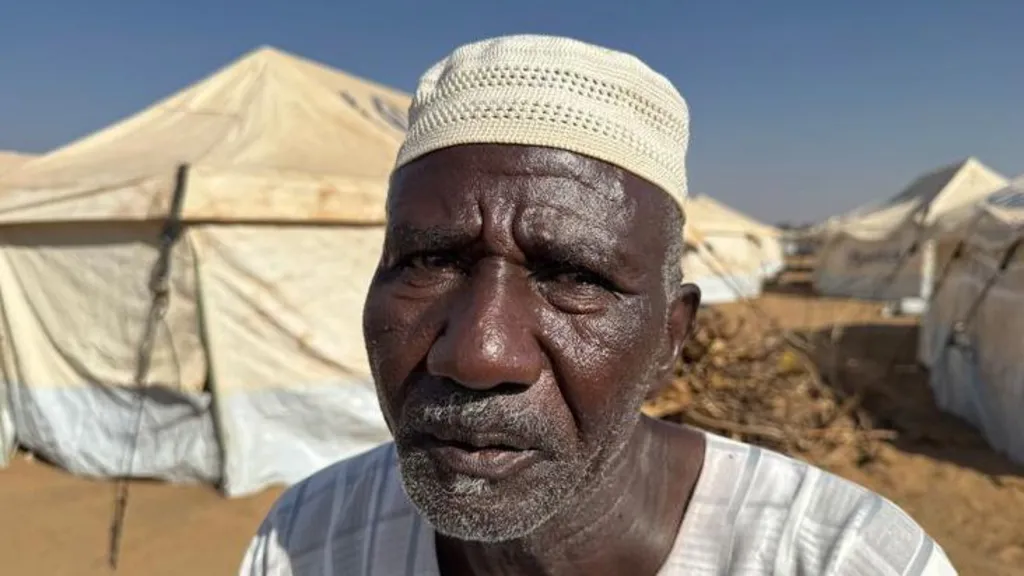
Abdulqadir Abdullah Ali spent nearly two years trapped inside the besieged city of el-Fasher in Sudan’s Darfur region. Diabetes medication became impossible to find, leaving him with severe nerve damage in his leg. Today, the 62-year-old walks with a heavy limp — but on the day fighters from the Rapid Support Forces (RSF) stormed the city, fear overpowered every physical limitation.
“When they came in, it was nonstop gunfire and explosions,” he recalled. “People were running in every direction — parents, children, everyone scattered.”
El-Fasher’s fall, after an 18-month blockade, has become one of the darkest moments of Sudan’s war. Those who fled have poured into displacement camps hundreds of miles away, describing scenes of terror and brutality as RSF troops seized the army’s last major stronghold in the region.
Ali reached a desert camp near al-Dabbah, almost 770km from his home city. Still trying to register his family for shelter, he described how civilians were gunned down in the streets.
“They shot at elderly people, at anyone they saw,” he said. “Some fighters drove over the injured to finish them off.”
He survived by running, crawling, and hiding until he reached the nearby village of Gurni — the first stop for thousands escaping the assault. Among them was Mohammed Abbaker Adam, an official who fled the Zamzam displacement camp after it was overrun months earlier.
“The road was covered with death,” Adam said. “Bodies left out in the open, some for days. People shot right in front of us, then dragged away.”
Many who escaped faced more danger on the road. Some were able to reach a humanitarian point in Tawila, while others crossed into Chad. But aid groups say less than half of the city’s population has been accounted for. Many simply vanished — unable to flee, detained, or unable to afford the bribes required to pass RSF checkpoints.
Sexual violence was also widespread. Women in the camp described assaults happening behind trees or out of sight, the survivors’ cries echoing in terror.
A 19-year-old woman recounted how RSF fighters dragged a girl from her group during a checkpoint search. She and her siblings continued on foot with their grandmother, who collapsed and died along the way. They carried on alone until reaching safety.
Her 15-year-old brother said he was forced into the sun for hours with other young men as fighters accused them of belonging to the army. They were beaten, threatened, and interrogated before finally being released.
Other survivors said men and boys were routinely separated from women during the escape. Abdullah Adam Mohamed, a perfume seller caring for his three daughters after his wife was killed months earlier, said he was torn away from his children in Gurni.
“I thought I would never see them again,” he said. “I’ve already lost so many.”
He later managed to escape and reunite with his daughters in Tur’rah before continuing the journey north.
At every stop, families say they were stripped of money, phones, and valuables. Many paid to pass through checkpoints after being forced to call relatives to send mobile transfers.
The RSF denies systematic abuses and claims accusations are politically motivated. They have released videos showing their fighters providing water and reopening clinics, which survivors dismiss as attempts to influence public perception.
“They pretend to help when the cameras are on,” Adam said. “When filming stops, the beatings start.”
Both sides in Sudan’s war have been accused of atrocities. Earlier this year, the United States determined that the RSF committed genocide in Darfur. The Sudanese army and allied groups have also been blamed for attacks on civilians and indiscriminate shelling.
The escalation has drawn renewed attention from President Donald Trump, who has pledged to push harder for a ceasefire.
For those who escaped, peace feels distant. Many have lost family, homes, and livelihoods — yet they continue to fight for survival.
Ali, still limping through the camp as he tries to secure a tent for his family, has not heard the latest diplomatic developments. He is simply focused on finding a place where his loved ones can “live and rest.”