
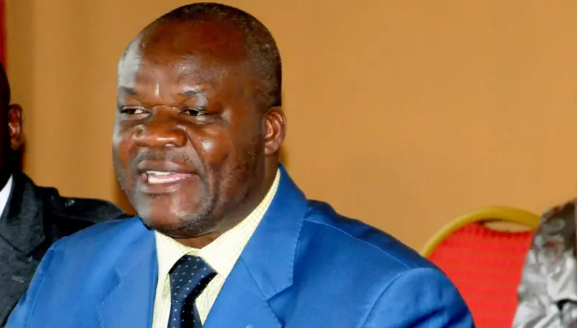
A French court has sentenced former Democratic Republic of Congo rebel leader and politician Roger Lumbala to 30 years in prison after finding him guilty of complicity in crimes against humanity committed more than 20 years ago.
The Paris court ruled that the 67-year-old was responsible for ordering, supporting, or facilitating serious crimes including torture, rape, sexual slavery, forced labour, summary executions, and large-scale looting during the Second Congo War.
Lumbala led the Rally of Congolese Democrats and Nationalists (RCD-N), a rebel group backed by Uganda that operated in eastern DR Congo between 2002 and 2003. The group was accused of carrying out brutal attacks during a military campaign known as “Erase the Slate,” which targeted members of the Nande and Bambuti ethnic communities in parts of Ituri and North Kivu.
A United Nations investigation later described the campaign as involving premeditated violence, using rape, executions, and looting as deliberate weapons of war.
Lumbala, who later served as a minister in Congo’s transitional government and as a member of parliament, fled to France after Congolese authorities issued an arrest warrant accusing him of backing the M23 rebel group. He was arrested in France nearly five years ago.
Although present in court to hear the verdict, Lumbala refused to participate in the trial and rejected the authority of the French judiciary. The case was pursued under the principle of universal jurisdiction, allowing French courts to try individuals accused of crimes against humanity committed abroad.
During the trial, 65 survivors, witnesses, and experts testified about the atrocities committed during the Erase the Slate operation. Survivors recounted killings, torture, sexual violence, and widespread destruction carried out by rebel forces under Lumbala’s leadership.
In a statement following the verdict, two survivors said the ruling marked a critical step toward justice after years of silence and impunity, even though they regretted not being able to confront Lumbala directly in court.
Lumbala’s legal team described the sentence as excessive and has 10 days to file an appeal. Prosecutors had requested a life sentence.
Human rights organisations welcomed the ruling, calling it a landmark moment in the fight against impunity for crimes committed during the Second Congo War, which claimed between two and five million lives between 1998 and 2003.
Eastern DR Congo remains unstable decades later, despite multiple peace agreements and the prosecution of several other militia leaders at international courts.