
Zambia’s Toxic Mine Disaster Sparks Battle Over Accountability as China Faces Scrutiny
When the mine dam gave way, Lamec already had misgivings about safety at the Chinese-operated copper site in northern Zambia. He says damaged protective gear often goes unreplaced, forcing workers to reuse worn-out equipment. Speaking privately on a backroad and withholding his real name, he fears losing his job for talking to journalists.
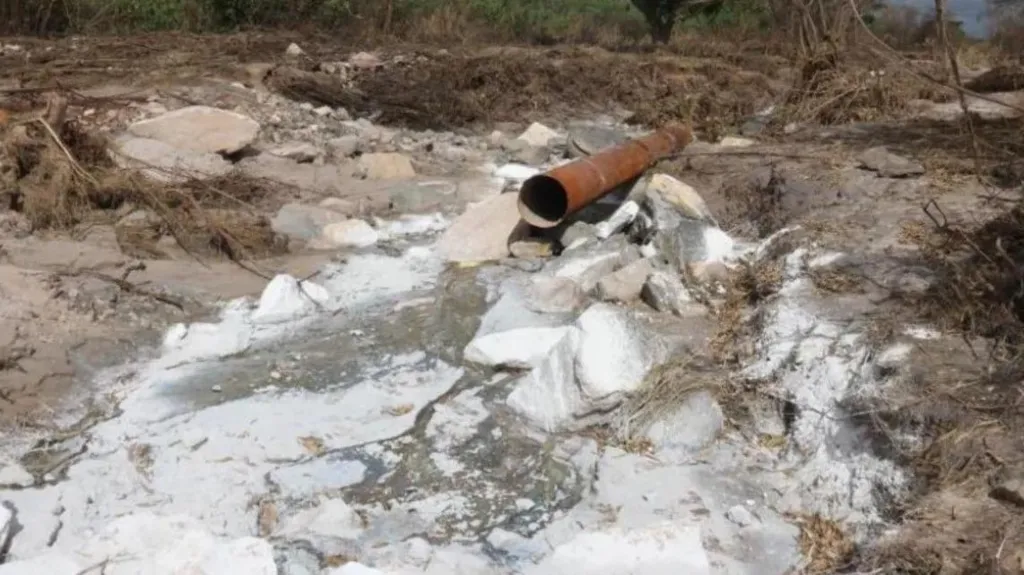
In February, he reported for his shift only to learn that one of the facility’s tailings dams—used to store hazardous waste containing arsenic, lead, mercury and other toxic materials—had collapsed into a tributary linked to the Kafue River, Zambia’s largest waterway and a critical source of drinking water.
Authorities estimate that more than 50,000 tonnes of acidic sludge surged into nearby streams, farmland and communities. Environmental experts warn the real figure may be much higher, possibly exceeding a million tonnes, and say the clean-up could stretch over a decade.
Local residents say fish have died off around Chambishi and Kitwe, crops have failed, and water has become unusable. With the rainy season now underway, specialists fear that remaining contaminated sediment will spread even further—possibly pushing heavy metals downstream toward Lusaka.
Health experts warn that the toxins involved can damage kidneys, increase cancer risk, and trigger long-term gastrointestinal problems.
China’s embassy disputes the scale of the disaster, saying government checks show water acidity has stabilized and that contamination was limited to a small area. Beijing says it supports an independent investigation.
A Delicate Balancing Act
Zambia’s situation mirrors Lamec’s dilemma. The mine is operated by Sino-Metals Leach Zambia, a branch of a Chinese state-owned company that, by its own account, employs more than 2,000 people. China remains one of Zambia’s largest economic partners, providing jobs, investment, and revenue—particularly in the mining-rich Copperbelt.
Chinese companies collectively support over 30,000 Zambian jobs, and investment reached an estimated $1.7 billion last year. Beijing’s Premier Li Qiang even visited Zambia recently, signalling close ties.
But China’s role across Africa remains controversial. Critics accuse Beijing of environmental neglect, failing to train local workers, and burdening African economies with unsustainable loans. Sino-Metals and NFC Africa now face a massive $80 billion lawsuit filed by 176 farmers—the largest environmental case in Zambia’s history—alleging that engineering failures and operational negligence led to the dam’s collapse. The case is being viewed as a landmark test of whether African governments can hold powerful foreign investors to account.
Government Response and Rising Pressure
Zambian officials insist that China will not receive special treatment. The Ministry of Green Economy and Environment says investigations are ongoing, that mitigation orders have been issued, and that Beijing’s financial leverage—Zambia owes China an estimated $5 billion—will not influence the government’s response.
China says the mine operator has cooperated with authorities, maintained staff salaries during a six-month shutdown, and issued compensation to over 450 households. Some residents say they received up to $3,000, while others claim they received far less. Some compensation agreements reportedly require residents to waive future claims.
Environmental analysts caution that heavy metals can linger in soil for more than a decade if not properly treated. Copperbelt University researchers warn that a failure to manage the situation promptly could have severe long-term consequences for thousands of farmers.
Communities Struggling to Survive
In villages like Twalima, farming families say they can no longer grow enough food. Abigail Namtowe says her six-year-old daughter is malnourished as crops fail repeatedly. Longtime farmer Frederick Bwalya says the polluted soil has ruined his land and that he now suffers persistent leg pain believed to be linked to contaminated water. Promised boreholes, he says, have not been built.
Despite government assurances that tests in September showed heavy metal levels within national safety limits, residents remain fearful—especially as children continue to swim in contaminated tributaries.
A Geopolitical Crossroads
Analysts believe Zambia’s position is strengthened by its growing ties with the US, which is competing with China for influence across Africa. Zambian copper and cobalt—key minerals for renewable energy and electric vehicles—remain in high demand globally.
Experts say Africa is increasingly charting its own course, engaging multiple global powers while navigating mistakes and learning to exercise stronger oversight.
China rejects accusations of neocolonialism, insisting its partnership with Zambia is built on mutual benefit, job creation, and economic growth. Beijing argues it is unfair to judge its role based on isolated criticisms when broader cooperation has delivered major gains.