
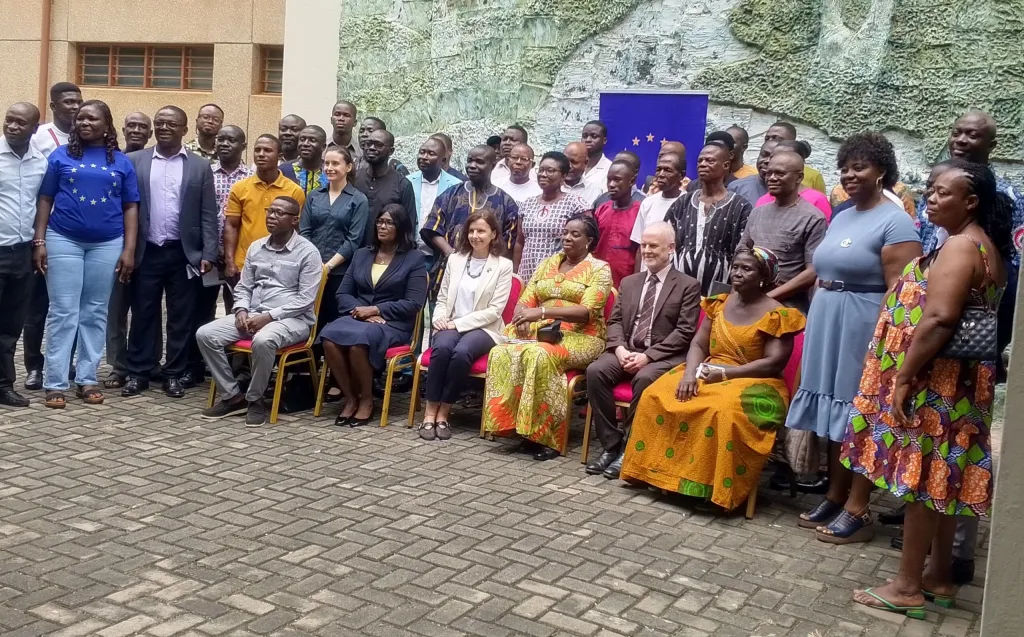
The European Union has launched a €2.4 million Forest Restoration Project aimed at rehabilitating 5,000 hectares of Ghana’s degraded forest landscapes while empowering 20,000 farmers and rural households. The project was unveiled at the Forest Research Institute of Ghana (FORIG) in Fumesua, within the Ejisu Municipality of the Ashanti Region.
Ghana’s forests play a critical role in biodiversity conservation, climate resilience, and food and water security, while supporting thousands of livelihoods, especially in fringe communities. However, expanding mining operations, unsustainable farming, wildfires, and illegal logging continue to rapidly degrade the country’s forest cover.
To address these challenges, the EU is funding the initiative through four local NGOs:
Goshen Global Vision – leading community landscape restoration
Nature & Development Foundation – driving agroforestry to accelerate restoration
Proforest Initiative Africa – supporting partnerships to rehabilitate the Asunafo landscape
World Vision Ghana
These organizations are required to prioritize women and youth while promoting sustainable livelihoods and strengthening community resilience.
The project will cover communities across the Ahafo, Bono East, Upper East, and Western Regions.
At the launch, Ms. Paulina Rozycka, Head of Infrastructure & Sustainable Development at the EU Delegation in Ghana, said the initiative forms part of the EU’s broader Sustainable Forest and Cocoa Programme, which promotes climate-smart agriculture and resilient landscapes.
“This programme supports sustainable value chains, climate-smart agriculture, and strategic landscape restoration,” she said. She also highlighted that the EU views forest degradation as a major threat to ecosystems and economies, noting that the project aligns with the government’s ‘Tree for Life’ initiative.
Ms. Rozycka further emphasized Ghana’s progress in the forestry sector, referencing the rollout of FLEGT licensing for timber exports to the European market—a milestone that confirms Ghana’s commitment to legal timber production and stronger forest governance.
Deputy Director of FORIG, Dr. Lucy Amissah, identified illegal mining (galamsey) and unsustainable farming as the biggest threats to forest conservation. She expressed optimism that the new project would promote responsible land use and accelerate restoration efforts.
A representative from the Forestry Commission, Mrs. Valerie Fumey Nassah, pledged the Commission’s full support, stressing that the initiative aligns with its mandate to manage forests for the benefit of all Ghanaians.
The ceremony concluded with dignitaries planting trees at FORIG to officially signal the beginning of the restoration programme.