
On a secluded farm in South Africa’s Free State province, heavy electric steel gates slide open as Marthinus—an Afrikaner farmer—drives in. Towering fencing, security cameras, and coils of barbed wire surround his home. To him, it feels less like a farm and more like a fortress.
“It’s like living in a prison,” he says. “If someone wants to kill us, they will still try, but at least it will take them longer to reach us.”
Marthinus, who asked that only his first name be used, carries deep personal trauma. Both his grandfather and his wife’s grandfather were murdered in farm attacks. And not far from his home, the body of a 21-year-old farm manager, Brendan Horner, was found five years ago tied to a pole, reigniting national debate about rural insecurity.
Fearing for his family, Marthinus and his wife applied for refugee status in the United States earlier this year.
“I’ll give up everything if it means safety for my children. Nobody deserves to live in fear,” he says.
He believes Afrikaners “are an endangered people.”
A Divided White Community
Many white South Africans, especially Afrikaners, have increasingly sought resettlement in the U.S. since President Donald Trump signed an executive order prioritizing them and other groups claiming discrimination. While the U.S. has drastically reduced its overall annual refugee quota—from 125,000 to 7,500—the policy gives preference to Afrikaners.
However, not all white farmers agree on the narrative of racial persecution.
Crime Affects All Farmers
South Africa continues to battle one of the world’s highest violent crime rates. Official data for the first quarter of 2025 recorded an average of 63 murders a day.
In the same Free State region, black farmer Thabo Makopo tends to his sheep and cattle on a 237-acre farm. Like his white counterparts, his biggest challenge is the constant threat of armed attackers.
“These are dangerous young men. Once they want your livestock, they will take it at any cost,” Thabo says. “It can happen to anyone—black or white.”
Another farmer, Morgan Barrett, who patrols his 2,000-acre family land nightly after losing several cattle, dismisses the idea that race is the main motive behind attacks.
“If criminals believe someone—black or white—has cash locked in a safe, they’ll attack. It’s not about skin colour,” he says.
Claims of “White Genocide” Spark Debate
Despite local statistics refuting targeted racial killings, claims of a so-called “white genocide” continue to circulate, amplified at times by figures including Trump and South African-born billionaire Elon Musk.
But South Africa’s government has repeatedly rejected these claims. Police Minister Senzo Mchunu revealed that between October 2024 and March 2025, there were 18 farm murders: 16 black victims and 2 white victims.
Authorities do not publish crime data by race, but this breakdown was released to counter misinformation spreading online.
A Country Still Healing From Apartheid
Racial inequality in South Africa remains deeply rooted, a legacy of the apartheid system that legally segregated people for nearly half a century. White South Africans still own more private farmland than any other group—around 72%, according to the 2017 Land Audit.
The government has attempted land reform, including a new law allowing controlled land expropriation without compensation in very limited cases. But broad redistribution has progressed slowly, and farm attacks affect all racial groups.
Crime Hits Families Everywhere
In Meqheleng township near Ficksburg, shop owner Nthabiseng Nthathakana lost her husband, Thembani, during a violent robbery in January. He was shot, stabbed, and beaten.
Now raising four children alone, she still has no answers.
“The kids ask who killed their father, and I don’t know what to tell them,” she says.
A One-Way Ticket Out
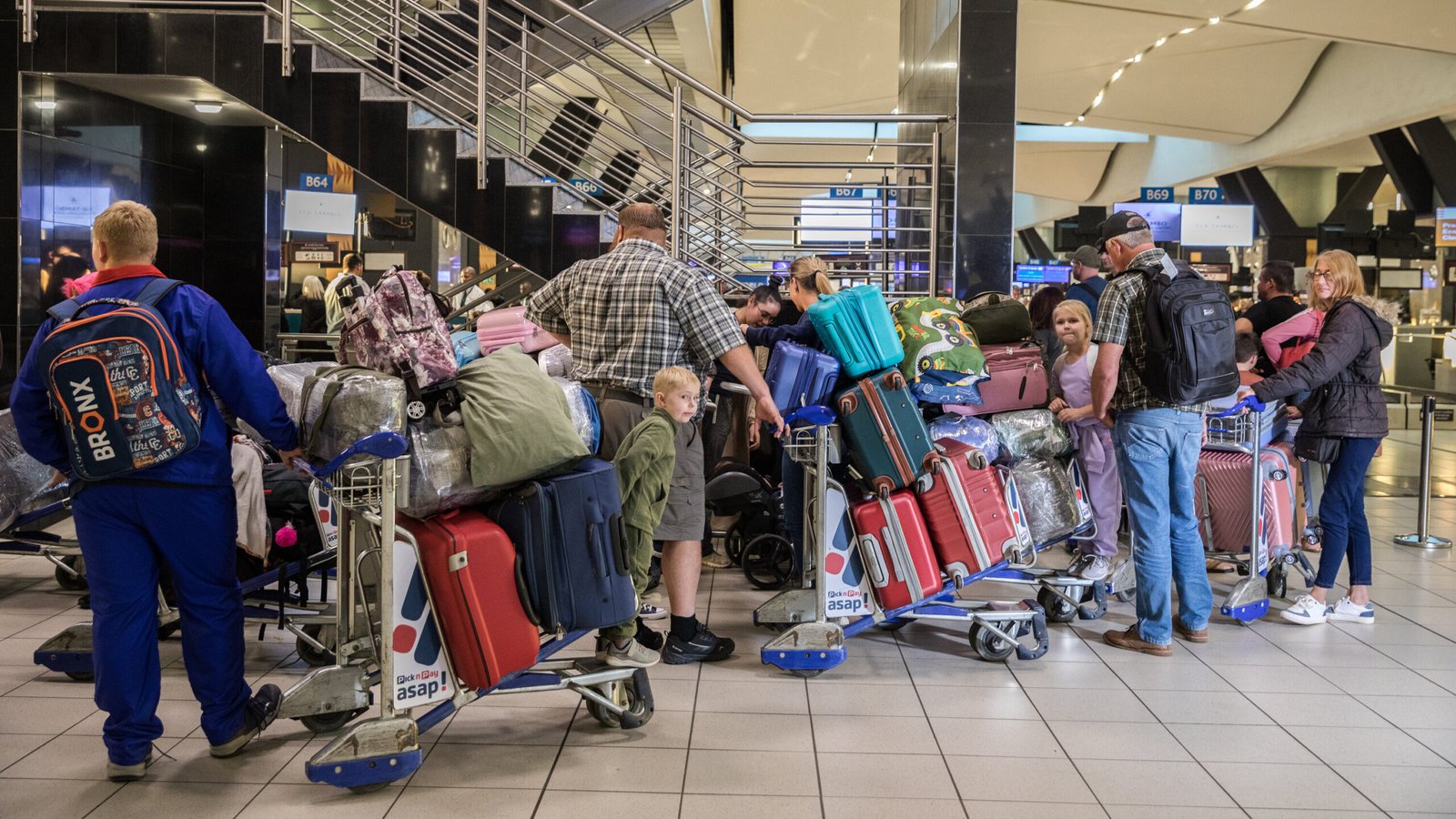
Meanwhile, Marthinus and his family have just received confirmation that their U.S. refugee application has been approved. They are preparing for the move.
He insists white South Africans are being politically targeted, a view contested by many, yet one he firmly holds as he prepares to leave.
“I’m grateful to be getting away from this constant fear,” he says. “God has answered our prayers.”