
A Tunisian appeals court has handed down heavy prison sentences to dozens of political figures, activists and business personalities accused of plotting to remove President Kais Saied from power. The verdict marks one of the most sweeping crackdowns since Saied assumed near-absolute authority in 2021.
In total, 40 individuals were convicted on charges of conspiring against state security, receiving sentences between four and 45 years. Many of them, including prominent opposition leader Jawahar Ben Mbarek, have been held in detention since 2023, while 20 others were tried in absentia after fleeing the country.
Tunisian officials claim the group—among them former intelligence chief Kamel Guizani—coordinated efforts to destabilise the state and overthrow the president. Critics, however, say the trial was used as a political weapon to silence dissent in a country where democratic progress has sharply deteriorated since Saied suspended parliament and began ruling by decree.
Ben Mbarek and leading opposition figures Issam Chebbi and Ghazi Chaouachi were each sentenced to 20 years in prison. Businessman Kamel Ltaif received the harshest punishment with a 45-year sentence, while political figure Khyam Turki was handed a 35-year term. Ben Mbarek has reportedly been on a hunger strike for more than a month and is said to be in critical condition.
Among those sentenced in absentia were feminist activist Bochra Belhaj Hmida and French philosopher Bernard-Henri Lévy. The appeals court upheld most of the earlier convictions from April while increasing several sentences, deepening concerns from rights groups that Tunisia’s judicial system is being used to crush opposition voices.
Amnesty International criticised the verdict as “unjust” and emblematic of a judiciary being used to eliminate political opposition. Previous concerns raised by the UN also warned that Tunisia was misusing national security and counterterrorism laws to target critics.
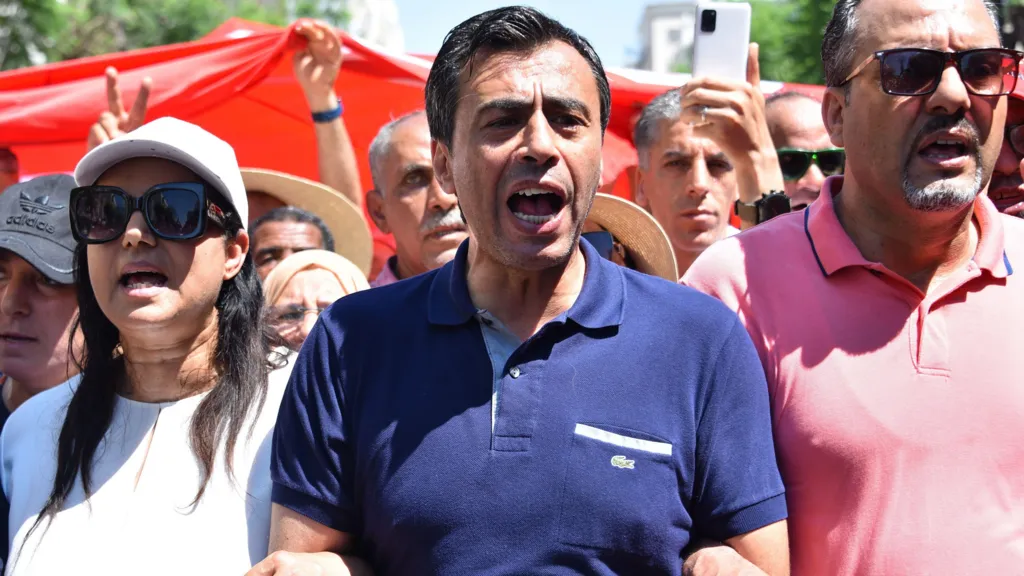
Public frustration has also spilled into the streets. Thousands of Tunisians marched through the capital over the weekend, denouncing President Saied for what they say is the entrenchment of one-man rule through systematic repression.
Saied, who rose to power in 2019 on a wave of public frustration with corruption and political gridlock, oversaw Tunisia’s shift away from the democratic gains made after the Arab Spring. The latest court rulings further cement concerns that the country is drifting firmly back toward authoritarian governance.