
Donald Trump’s sudden military operation in Venezuela has sent shockwaves far beyond Latin America, tearing apart a relationship that China had spent decades carefully building and leaving Beijing facing uncertainty it neither wanted nor planned for.
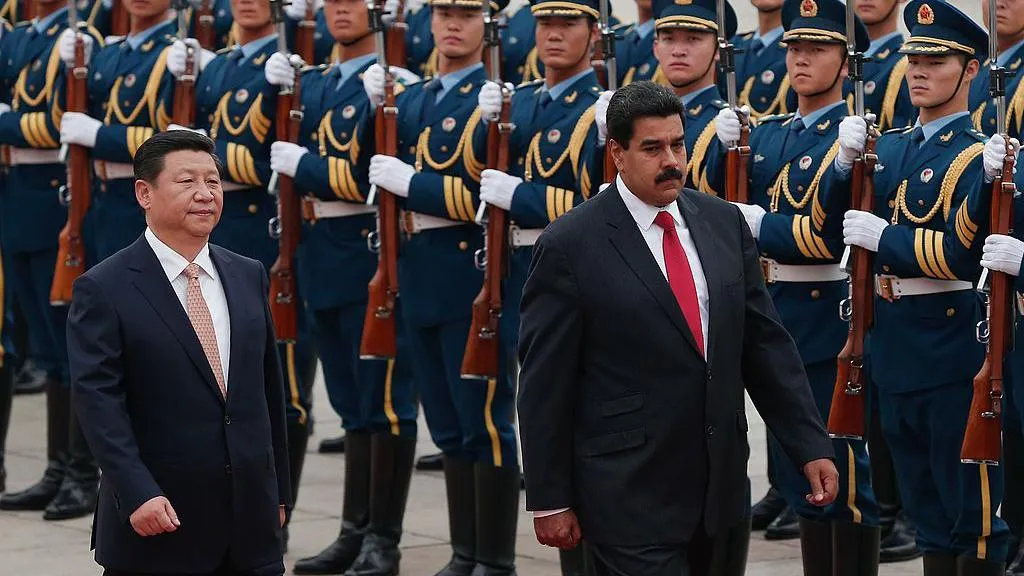
Just hours before his capture in a dramatic night-time raid, Venezuelan leader Nicolás Maduro had been publicly praising Chinese President Xi Jinping, describing him as an “older brother” and a powerful global leader during a meeting with senior Chinese diplomats. Chinese state media prominently showcased the encounter, highlighting hundreds of bilateral agreements between Beijing and Caracas. Within hours, however, images of Maduro blindfolded and handcuffed aboard a US warship replaced those carefully curated scenes.
China joined a chorus of international condemnation, accusing Washington of behaving like a global enforcer and violating international law by acting against a sovereign state. Beijing stressed that national sovereignty and security must be respected, but behind the strong rhetoric lies a far more complex calculation.
China has invested heavily in Venezuela, one of its most important partners in South America and a critical oil supplier. Now, Beijing must weigh how to protect its interests while managing an already tense and unpredictable relationship with Trump, as competition between the world’s two biggest powers enters a volatile new phase.
While some analysts see opportunity for China’s authoritarian leadership to expand influence, others warn the situation carries serious risks. Beijing traditionally favors stability and long-term planning, not sudden disruptions. Trump’s second term has already challenged that preference, from revived trade tensions to now a direct intervention in China’s strategic backyard.
Trump’s aggressive pursuit of Venezuelan oil has reinforced China’s deepest suspicions about US intentions and how far Washington is willing to go to curb Beijing’s global reach. That message was made explicit when US Secretary of State Marco Rubio declared that the Western Hemisphere would not be allowed to serve as a base for America’s rivals.
China has pushed back strongly, condemning reports that Washington may pressure Venezuela’s interim leadership to cut economic ties with Beijing and Moscow. Chinese officials described such moves as bullying and a direct assault on Venezuela’s sovereignty and the rights of its people.
The episode has also sparked online debate within China, with some nationalist voices questioning whether similar tactics could one day be applied elsewhere, including Taiwan. While analysts say such comparisons are flawed, the Venezuela operation has undeniably heightened Beijing’s concerns about precedent and power projection.
For China, the relationship with Venezuela was once straightforward: Beijing provided funding and infrastructure investment, while Caracas supplied oil. Between 2000 and 2023, China extended more than $100bn in financing to Venezuela, and last year roughly 80% of Venezuelan oil exports went to China. Yet even that accounted for only a small fraction of China’s total oil imports, putting the scale of its exposure into perspective.
Still, Chinese energy firms and lenders face potential risks amid the turmoil, including uncertainty over assets and unpaid loans. The broader concern is that instability and US intervention could deter future Chinese investment across Latin America, a region vital to China’s food, energy, and raw material supplies.
Beijing is now walking a diplomatic tightrope. It does not want to jeopardise a fragile trade truce with Washington, but it also cannot afford to lose ground in a region where it has patiently expanded influence for years. Meanwhile, US pressure on Chinese interests elsewhere, including around the Panama Canal, has only added to Beijing’s unease.
China’s response may ultimately be to double down on its long-standing message to the Global South: opposition to unilateral actions and a promise of predictable partnership. As Trump’s moves inject uncertainty into US relationships, Beijing will likely seek to present Xi as a steady and reliable alternative.
The risk, analysts warn, is that Venezuela could descend into prolonged chaos, echoing past US interventions where promises of reconstruction funded by oil never materialised. If that happens, China may once again find itself waiting on the sidelines, ready to step back in once the dust settles.
For now, Trump has made his move. What remains unclear is what comes next — and whether this high-stakes gamble will reshape global power dynamics in ways even Beijing cannot control.