
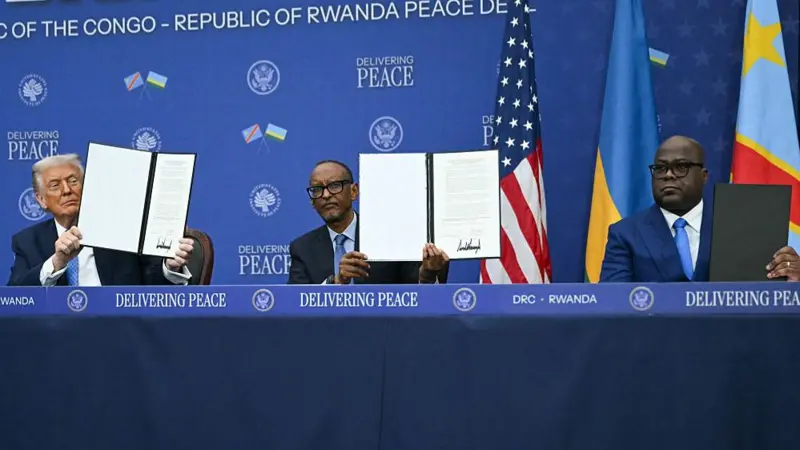
The Democratic Republic of Congo (DR Congo) and Rwanda have formally signed a peace agreement aimed at ending years of deadly conflict in eastern DR Congo, during a high-profile ceremony hosted by U.S. President Donald Trump in Washington.
The signing comes amid renewed clashes in the mineral-rich eastern region, where fighting between DR Congo’s army and the M23 rebel group intensified in the days leading up to the summit. Government forces accused rebels of trying to undermine the peace process, while M23 claimed the military had broken a ceasefire by launching fresh attacks.
M23 captured large parts of eastern DR Congo earlier this year, displacing thousands and escalating tensions between the two neighbouring nations.
Speaking at the ceremony held at the newly renamed Donald J. Trump Institute of Peace, Trump described the event as “a great day for Africa and the world,” expressing confidence that both nations would honour their commitments.
DR Congo’s President Félix Tshisekedi and Rwanda’s President Paul Kagame—who have frequently traded accusations over the conflict—endorsed a peace accord first signed by their foreign ministers in June. The event drew leaders from Kenya, Angola, Burundi, Togo, and Uganda’s vice-president, as well as diplomats from Qatar and the UAE. U.S. Secretary of State Marco Rubio was also present.
Kagame commended Trump for what he called an “even-handed” approach, praising the U.S. leader’s pragmatism. Tshisekedi expressed gratitude but emphasized the need for Rwanda to respect the terms of the agreement.
The M23 rebel group did not attend the Washington ceremony. It remains in separate talks with DR Congo mediated by Qatar, which is coordinating its efforts with the United States. Qatar’s influence is considered crucial due to its close ties with Rwanda.
The Trump administration hopes that resolving tensions between Rwanda and DR Congo will open the door for increased U.S. investment in the region. Trump pledged to send major American companies to both countries and openly discussed plans to access the region’s vast mineral wealth—resources essential to global industries such as electronics, renewable energy, and electric vehicles.
Despite the diplomatic breakthrough, analysts remain sceptical about the likelihood of immediate peace. Bram Verelst, a researcher with the Institute for Security Studies, noted that there is currently “no ceasefire in place” and said M23 continues to strengthen its control in areas it occupies.
Fresh clashes were reported days before the peace signing, including new rebel offensives in South Kivu. The M23 claims DR Congo’s forces launched attacks with support from Burundi, a claim Burundi has not addressed.
The Rwanda-DR Congo conflict remains entangled with the presence of the FDLR, a militia with members linked to the 1994 Rwandan genocide. Rwanda insists the group must be disarmed, while DR Congo demands a withdrawal of Rwandan forces from its territory—both conditions included in the new peace agreement.
Several earlier peace deals have collapsed over disagreements regarding the FDLR’s demobilization and M23’s refusal to relinquish seized territory. DR Congo has stated it will not progress with new economic cooperation frameworks until Rwandan troops withdraw.
The region’s enormous mineral reserves—estimated at $25 trillion—remain central to international interest and to U.S. diplomatic engagement. Analysts say Washington is pushing for long-term economic cooperation between Rwanda and DR Congo in areas such as hydropower, infrastructure, and mining, hoping economic benefits will reinforce stability.
However, progress depends heavily on military de-escalation and political trust between the two states.