
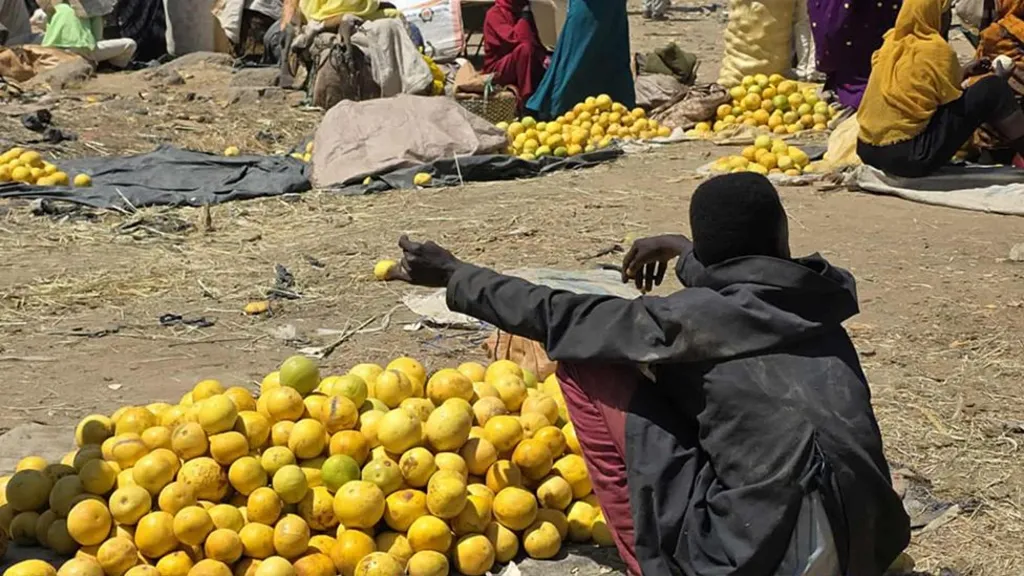
In the heart of Sudan’s Jebel Marra mountains lies a region that feels strangely detached from the brutal civil war engulfing the rest of the nation. Here, life still follows the rhythm of the earth. Each morning, women draped in colorful cloths ride donkeys to their farms, children trailing behind as laughter briefly breaks the silence of conflict.
The mountains are rich and green, blessed with cool Mediterranean-like weather and fertile soil that nourishes peanuts, apples, strawberries, and oranges — crops that stand in stark contrast to the widespread famine crippling the country. Before war took hold, Jebel Marra’s oranges were famous nationwide for their sweetness and freshness.
But today, even as Sudan faces one of the world’s worst food crises — with nearly 25 million people struggling with hunger and over 600,000 enduring famine, according to the UN — the tragedy in Jebel Marra is not the failure to grow food, but the impossibility of moving it.
“We end up selling for almost nothing, sometimes throwing away what we can’t sell before it spoils,” says Hafiz Ali, an orange vendor from Golo town, the unofficial heart of this mountain region.
Trapped in Isolation
The roads that once connected Jebel Marra to the rest of Sudan have become treacherous. Landslides, mud, and armed checkpoints make transportation nearly impossible. The region remains under the control of the Sudan Liberation Army–Abdulwahid (SLA-AW), a rebel faction that has stood its ground for over two decades. Although the group has stayed neutral in the current war, its territory is now surrounded by violence on every side.
To the north and west, the Rapid Support Forces (RSF) and allied militias control access routes. To the east, RSF positions face frequent bombings by Sudan’s national army, endangering nearby civilians. The southern paths are no safer. With every route blocked or dangerous, Jebel Marra has become an island of abundance trapped within a sea of chaos.
Markets in the nearby cities of El-Fasher and Tine — once major trading hubs — are now unreachable. Smaller markets like Tawila and Nertiti have emerged as temporary alternatives, but transporting produce there is an ordeal. “Driving just 12 kilometers can take a whole day in the mud,” explains Yousif, a fruit vendor. “And now, you risk your life every time you make the trip.”
Fragile Markets and Constant Threats
A fragile truce between the Fur farmers of Jebel Marra and nearby Arab nomads has allowed limited trade to resume. Once a week, the market at Nertiti comes alive — Fur farmers bring fruits and vegetables, while Arab women trade dairy and other goods. Yet, even this fragile peace is overshadowed by danger. “The market opens only once a week, and even then, armed robberies are common,” says one trader nervously.
In RSF-held Zalingei, markets also operate, but traders face harassment and extortion at countless checkpoints. Some of these barriers are manned by a single armed man demanding payment before letting vehicles pass. Travelers whisper prayers as they negotiate for their safety.
Inside the SLA-AW territory, checkpoints are just as frequent. Guards inspect every bag, sometimes confiscating harmless personal items like skin-bleaching creams. Yet beyond these restrictions lies a semblance of calm, a fragile peace where the war’s echo feels distant but ever-present.
Refuge in the Mountains
In Golo, now the de facto capital of the SLA-AW zone, schools and clinics have turned into shelters. Every day, new families arrive, fleeing the bombardments in El-Fasher. Among them is a woman who once worked as a nurse. “I can farm, but the land here belongs to others. We have nothing left,” she says, surrounded by exhausted elders and hungry children.
Ironically, while food rots in the markets, displaced families within Jebel Marra survive on scraps. Humanitarian aid rarely reaches them, blocked by endless checkpoints and insecurity.
A Land of Beauty and Despair
Jebel Marra remains a haunting paradox — a region of waterfalls, green hills, and fertile farms surrounded by war and famine. It is a place of color and hope where life persists, but also a place of frustration where abundance turns to waste.
As one weary trader put it, “We are not part of this war. We just want to sell our oranges.”