
As snow falls steadily on the outskirts of Kyiv, two blue-and-white railway carriages sit idling at a suburban station. They are not heading anywhere, but for dozens of residents left without electricity, water or heating, they have become a lifeline.
These carriages are part of Ukraine’s so-called Invincibility Trains — emergency shelters created to help civilians survive a brutal winter that has collided with renewed Russian attacks on energy infrastructure.
Inside one carriage, Alina watches her infant son Taras play with donated toys. Outside, temperatures in Kyiv have plunged to as low as –19°C when wind-chill is factored in.
“I live on the 17th floor of a new building,” she says. “But there’s no elevator, no electricity and no water.”
For her, the train is not only warm but also safe — a place where her children can briefly escape the cold and fear.
Her voice breaks as she speaks about her father, who was killed two years ago during fighting near Bakhmut. Regaining her composure, Alina says she will return to the train again, grateful for even temporary relief from freezing nights and constant air raid alerts.
Ukraine’s President Volodymyr Zelensky has accused Russia of deliberately using winter as a weapon, targeting power stations, storage facilities and other critical infrastructure. Kyiv Mayor Vitali Klitschko has gone further, controversially suggesting that residents who can leave the city temporarily should do so to reduce pressure on limited resources — a remark quickly exploited by Russia as evidence of weakness.
Despite the hardship, most Kyiv residents remain defiant.
For Yulia Mykhailiuk and Ihor Honcharuk, survival means heating bricks on a gas stove to warm their small apartment, where they now live with their one-year-old son after their own home was damaged in a Russian strike last summer.
“We had electricity today for maybe four minutes,” Ihor says. “All our power banks are empty.”
Large backup batteries, now common in Kyiv homes, offer little help for heating, draining almost instantly. The only option for now is dressing their baby in layers. This weekend, they plan to leave the city temporarily for family outside Kyiv — a decision they say is practical, not political.
Nearby, a recent drone strike has torn into another apartment block, a reminder of the constant danger. With a population of more than three million, Kyiv has absorbed repeated waves of Russian strikes, and the cumulative damage is now worse than in previous winters.
City officials say recent attacks triggered the worst power outage Kyiv has faced so far this season, leaving hundreds of residential buildings in darkness.
Energy experts warn that repairs are becoming increasingly difficult. Frozen ground, ice-covered cables and repeated damage mean restoration efforts now take two to four times longer than before.
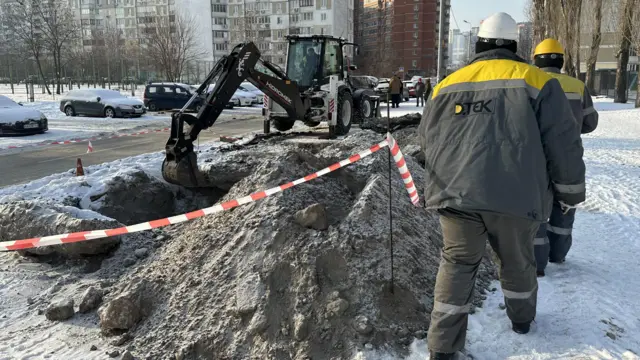
Across the city, engineers work around the clock, sometimes with bare hands in freezing conditions, repairing cables that supply massive apartment complexes. Authorities have urged residents to avoid high-energy appliances, as sudden surges in demand when power returns often cause the system to fail again.
“We are operating in emergency mode,” says Andrii Sobko, part of a power grid repair crew. “The equipment is running at critical limits just so people can have light.”
The human toll of the war is impossible to escape.
Eleven-year-old Stanislav, known as Stas, visits the Invincibility Train to warm up and charge his phone after his family went 36 hours without power. He vividly remembers the first day of the war, nearly four years ago, when flashes lit up the sky.
Now it’s the sound of drones that keeps him awake at night.
“When I hear something flying, it’s scary,” he says. “You don’t know if it will explode or pass by.”
Despite everything, he smiles easily. But his words reveal a deeper loss. “I don’t remember life without war,” he says quietly. “Life is difficult.”
As an air raid alert suddenly sounds, conversations on the train stop. The conductor orders everyone to leave and head for shelters. Some return home to freezing apartments and unreliable power, but many say they will be back the next day.
Kyiv is enduring one of its harshest winters in recent memory. While the cold will eventually ease, what troubles residents most is the fear that the war — and its relentless human cost — has no clear end in sight.