
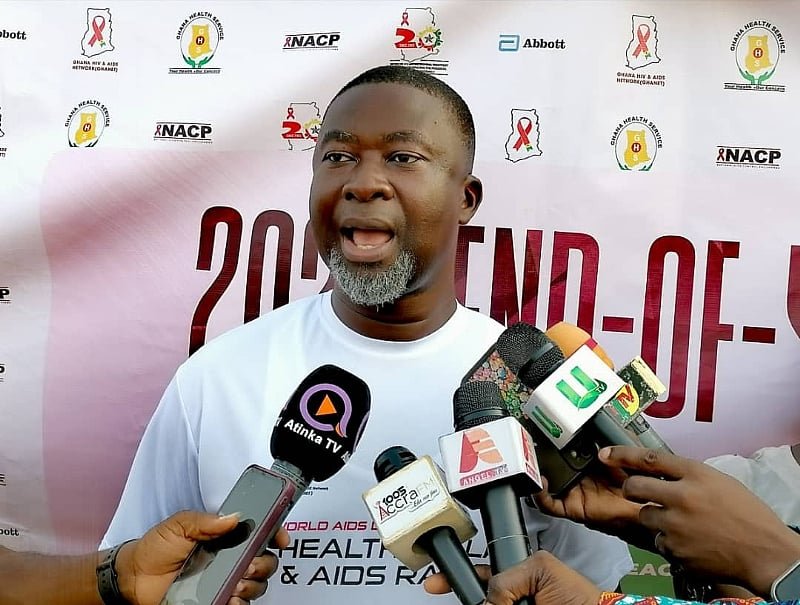
Ghana is seeing a troubling rise in new HIV infections, raising alarm among health experts and civil society groups who warn that the government’s failure to operationalize the National HIV and AIDS Fund could undo decades of progress in the fight against the virus.
According to Ernest Amoabeng Ortsin, President of the Ghana HIV and AIDS Network (GHANET), the surge is being driven by a sharp decline in public education and awareness campaigns, which once played a critical role in prevention efforts.
“For over 15 years, we’ve slowed down on public awareness. Many young people today know little to nothing about HIV,” Mr. Ortsin explained. “Most of them only fear pregnancy, not realizing that HIV and other STIs remain serious threats.”
A Generation Growing Up Uninformed
The current rise in infections is particularly concerning among young adults aged 18 to 25, who were too young to experience the aggressive anti-HIV campaigns of the 1990s and early 2000s. Mr. Ortsin said this generational gap in awareness directly reflects the lack of funding for prevention programs.
He noted that while treatment remains available, preventive education — once the backbone of Ghana’s HIV response — has nearly vanished.
National HIV Fund Still Dormant
The Ghana AIDS Commission, established in 2002, initially received major support from the Global Fund to Fight AIDS, Tuberculosis and Malaria. That funding covered both treatment and prevention programs for years. However, the Global Fund later shifted its focus primarily to purchasing antiretroviral drugs, leaving Ghana’s government to finance prevention and awareness.
“Government after government, we’ve failed to secure consistent funding for prevention,” Mr. Ortsin said. “The law establishing the National HIV and AIDS Fund was amended years ago to make it operational, but as we speak, there’s no money in it. Each budget comes and goes with no release of funds.”
He added that no Finance Minister has yet sought parliamentary approval for allocations into the fund, despite legal requirements to do so.
Infections Rising Amid Uncertain Funding
The consequences are already visible. In 2024, Ghana recorded 15,290 new HIV infections. Experts fear that without swift intervention, the numbers could climb even higher in 2025.
While Ghana still receives limited medical support from the Global Fund, future allocations are uncertain. International contributions have declined, especially after U.S. budget cuts to global health initiatives.
“If Ghana loses that support in 2027, the government will have to buy the drugs itself — and that will be very expensive,” Ortsin warned. “The outlook is worrying.”
Falling Behind Global HIV Targets
The UNAIDS 2030 target aims to end AIDS by ensuring that 95% of people living with HIV are diagnosed, 95% of them are on treatment, and 95% of those on treatment achieve viral suppression.
Ghana, however, is lagging far behind. Current estimates suggest there are about 334,000 people living with HIV, but only 68% have been diagnosed, and just 69% of them are on treatment.
“That means over 100,000 people are walking around with HIV without knowing it,” Ortsin said. “We’re not doing well as a country.”
Call for Immediate Government Action
With the 2026 national budget approaching, civil society organizations are urging the government to prioritize HIV funding and finally activate the long-stalled National Fund.
“We want to see the Finance Minister announce at least $100 million for the National HIV and AIDS Fund,” Ortsin emphasized. “The Ghana AIDS Commission was once vibrant and collaborative, but it’s now a shadow of its former self — underfunded and unable to mobilize NGOs, churches, and the media like before.”
He cautioned that without renewed investment, Ghana risks losing the progress made since the early 2000s.
“We must rally everyone again — government, faith-based groups, civil society, and the media — just like we did two decades ago. Otherwise, we’ll miss the global target of ending AIDS by 2030.”