
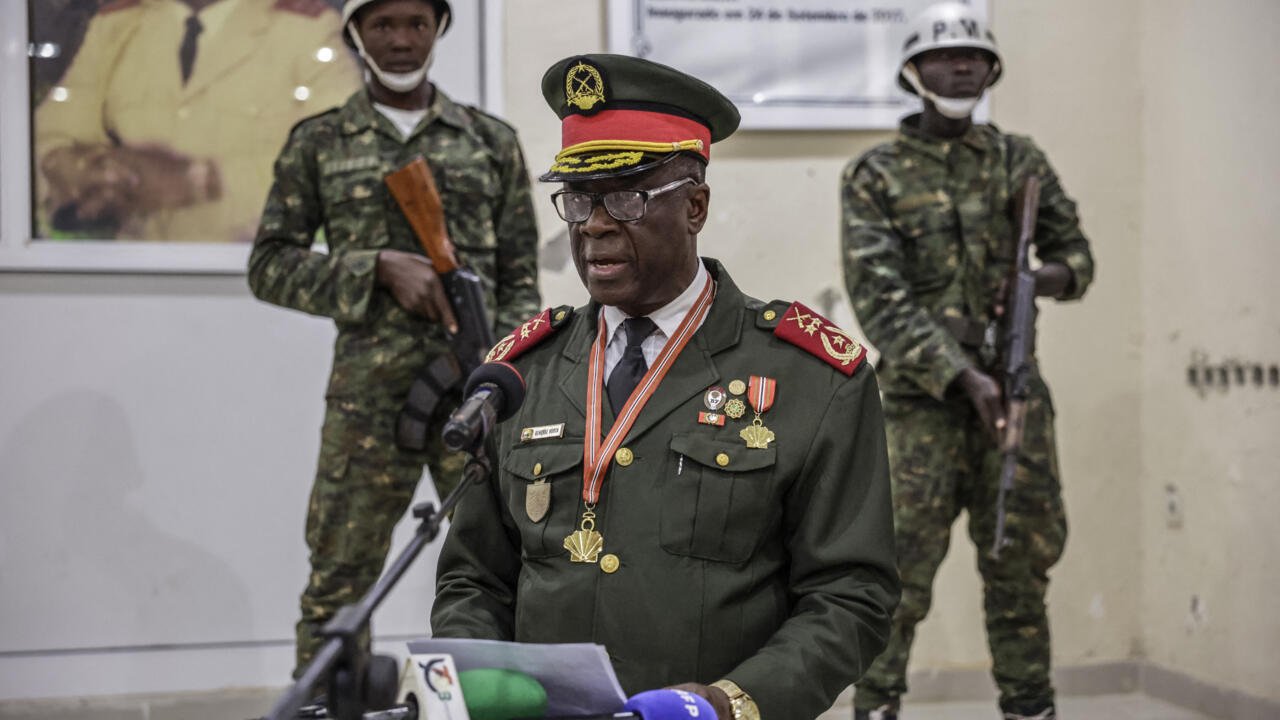
An army general has assumed leadership of Guinea-Bissau just one day after what appears to have been a coup.
Gen Horta N’Tam was sworn in as the country’s transitional president on Thursday, taking over for a one-year period in a quiet ceremony held inside military headquarters.
Until Wednesday, N’Tam served as the commander of the presidential guard. During the swearing-in, he maintained a stern expression as he stood outside alongside senior officers for official photographs.
Meanwhile, several civil society groups have accused outgoing President Umaro Sissoco Embaló of staging a “self-coup” with military backing, allegedly to prevent the release of election results he feared might not favor him. According to the Popular Front coalition, the move was intended to block the publication of results scheduled for 27 November.
His closest rival, Fernando Dias, has echoed these suspicions, although Embaló has not publicly addressed the allegations.
Embaló has long claimed to be the target of various coup attempts, but critics say he has often used claims of threats as a strategy to silence opposition.
The military has already halted the election process and stopped the release of results from Sunday’s vote, which were expected on Thursday.
A source within the military told reporters that Embaló is being held at army headquarters but is in good condition.
The African Union’s chairperson, Mahmoud Ali Youssouf, has condemned the situation, demanding the immediate release of Embaló and other detained officials, while reminding the country’s leadership to respect the ongoing electoral process.
Guinea-Bissau, located between Senegal and Guinea, has long grappled with political instability, its military influence, and its reputation as a major drug-trafficking corridor since independence in 1974. The nation has experienced at least nine coups or attempted coups over the last fifty years.
The latest upheaval unfolded on Wednesday, when military officers appeared on state television announcing they had taken control. Gunfire was reported in the capital, Bissau, though the details of the clashes and casualties remain unclear.
The officers also claimed they were trying to prevent a plan by unnamed politicians allegedly linked to a notorious drug trafficker. They declared the country’s borders closed and imposed a night-time curfew.
Both Embaló and Dias had already claimed victory in the tense election. Domingos Pereira, the former prime minister who had been barred from running, reportedly backed Dias.
Government insiders said not only Embaló but also Dias, Pereira and Interior Minister Botché Candé were taken into custody. Senior military chiefs, including Gen Biague Na Ntan and his deputy Gen Mamadou Touré, were also detained.
Regional bodies including the African Union and Ecowas expressed strong concern, noting that the election had been peaceful and that both major candidates had previously promised to respect the outcome.
Portugal, Guinea-Bissau’s former colonial power, has called for an immediate restoration of constitutional rule and urged all parties to avoid violence.
Despite the turmoil, borders were reported to have reopened on Thursday.
Embaló, 53, had hoped to become the first leader in three decades to secure a second consecutive term, although many questioned his legitimacy even before the delayed polls. Opposition groups had argued that his mandate ended in February 2025.
Guinea-Bissau, home to roughly two million people, remains one of the world’s poorest countries. Its scattered islands and remote coastline have made it a major transit hub for cocaine trafficked from South America into Europe — earning it the label of a “narco-state” by the United Nations.