
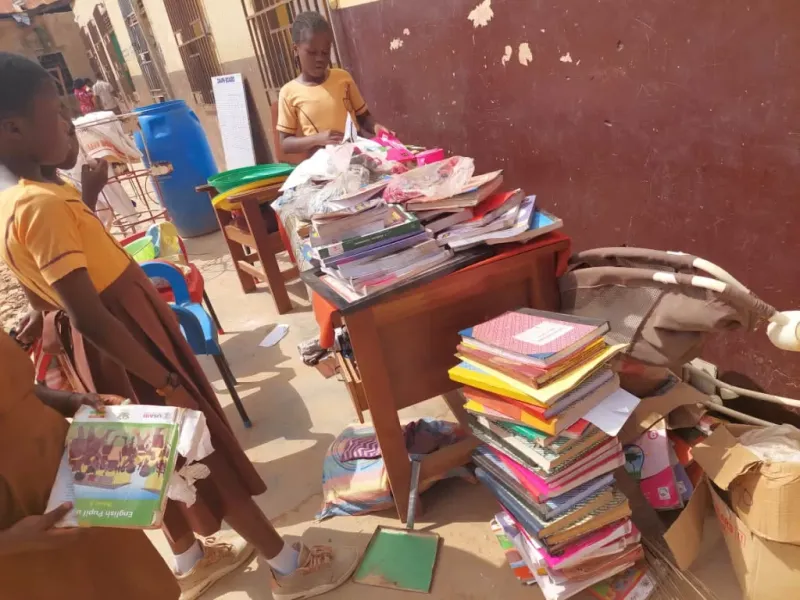
The Asuofua D/A Cluster of Schools in the Atwima Nwabiagya North District of the Ashanti Region has been struck by a double tragedy after a rainstorm and a fire outbreak ravaged parts of the already fragile school infrastructure.
The incident, which occurred during a heavy storm, caused major damage to several classroom blocks and destroyed essential teaching and learning materials, displacing hundreds of pupils.
A visit by correspondent Nicholas Osei-Wusu revealed that the fire—believed to have been sparked by a thunder strike—burned through several items, while the storm ripped off roofs and left deep cracks in some buildings, including the Block ‘D’ Kindergarten facility. The structural damage has placed the safety of pupils and attendants at serious risk.
The Asuofua D/A Cluster, established in the 1970s, serves a population of about 5,000 pupils across its preschool, primary, and junior high streams. The school’s buildings, most of which have not seen renovation for decades, are severely deteriorated and highly vulnerable to weather disasters.
This is not the first time the school has suffered such destruction. Two years ago, some classrooms collapsed and several roofs were blown off after a storm. Although former MP Benito Owusu Bio reroofed some blocks, others that collapsed remain unreconstructed to date.
In the latest disaster, the entire roof of JHS Block ‘A’ was torn off, forcing students to take lessons under trees. The attached Teachers’ Common Room also caught fire during the storm on Monday, December 1, 2023, but teachers who were still on the compound managed to prevent the fire from spreading further.
At Block ‘D’, the KG building has been rendered unsafe, with cracks and partial roofing damage posing a life-threatening hazard to the children.
Headmistress of the JHS Block ‘A’, Mrs. Charity Nseibo, described the situation as dire, saying both teachers and pupils feel unsafe and are compelled to study in harsh conditions.
“We don’t feel safe. We’re just in the hands of God,” she said. “Students and teachers are now under trees because we have no place else. When we sense rain coming, we have no choice but to close school.”
The disaster has struck at a critical time, as pupils are preparing for end-of-term examinations scheduled in a week. With the rainy season setting in, learning under trees has become even more challenging.
District Director of Education, Frank Duah Boateng, who visited the school, expressed concern over the lack of support from stakeholders and the poor state of the buildings. He stressed that the aging structures are a major contributing factor to the recurring disasters.
“The school is over 50 years old, serving 5,000 pupils, yet lacks proper renovation. We need to replace old roofing sheets and reinforce the buildings to prevent further incidents,” he stated.
Among the items destroyed were textbooks, registers, workbooks, lesson notes, pupils’ notebooks, and furniture. The destruction has worsened congestion in classrooms, with some now holding up to 92 pupils—more than double the recommended capacity.
Compounding the school’s challenges is an abandoned two-storey GETFund classroom block, which has been left to decay for five years and is now overgrown with weeds. Education officials have appealed to government and stakeholders to complete the project to ease overcrowding and restore safe teaching and learning conditions.