
Namibia has failed in its attempt to overturn the global ban on the international trade in black and white rhino horns, following votes at a major wildlife conservation summit.
The proposals were rejected earlier this week during sessions of the Convention on International Trade in Endangered Species of Wild Fauna and Flora (CITES), and the results were officially confirmed on Thursday at the ongoing conference in Samarkand, Uzbekistan.
Namibia had also sought approval to lift restrictions on African savanna elephant ivory, but that bid was equally dismissed.
The move attracted global attention because Namibia was one of the first countries to introduce dehorning in 1989 as a way to deter poachers by removing the commercial value of the horns. Other southern African countries — including Zimbabwe, Eswatini, and South Africa — later adopted the method.
Rhino horn remains highly sought after in parts of Asia, where it is used in traditional medicine and as a status symbol in markets such as China and Vietnam.
Namibia presented two separate proposals — one concerning black rhinos and another for southern white rhinos. Both were overwhelmingly rejected, securing only about 30 votes out of roughly 120, far below the two-thirds majority needed for approval.
Black rhinos are classified as critically endangered by the International Union for Conservation of Nature (IUCN), with only 6,421 remaining as of 2023 — a drastic decline of over 90% since 1960. Southern white rhinos are listed as near threatened, with 15,752 recorded last year. Their numbers, however, have also dropped, reaching their lowest point since the rhino-poaching surge began nearly 20 years ago.
Despite a CITES ban on rhino horn trade since 1977, poaching persists. More than 8,000 rhinos have been slaughtered across Africa in the past decade. Namibia recorded its highest poaching toll in 2022, with 87 rhinos killed — nearly double the previous year.
Although Namibia had not previously led its own proposal to lift the trade ban, it has consistently supported similar efforts pushed by South Africa, Eswatini, and Zimbabwe.
Experts believe that these countries seek to legalize trade largely because of the massive rhino horn stockpiles accumulated through dehorning operations.
According to wildlife policy specialists, Namibia is holding an estimated 6.45 tonnes of white rhino horn and 4.6 tonnes of black rhino horn. South Africa is thought to possess at least four times as much.
Dehorning removes the horn above its growth point — similar to trimming human fingernails — and does not harm the animal. But because horns naturally regrow, they must be removed repeatedly, leading to rapidly increasing stockpiles.
Some nations destroy confiscated horns — Kenya being a leading example — while others store them in hopes that legal trade may one day be permitted.
Supporters of legal rhino horn trade argue that income from controlled sales could significantly boost conservation funding, particularly for private rhino owners who face soaring security costs.
Opponents warn that opening trade would intensify global demand and trigger renewed poaching on a scale far greater than current levels. They argue that legal markets in some Asian countries historically played a major role in fueling the poaching crises of the 1970s and 1980s.
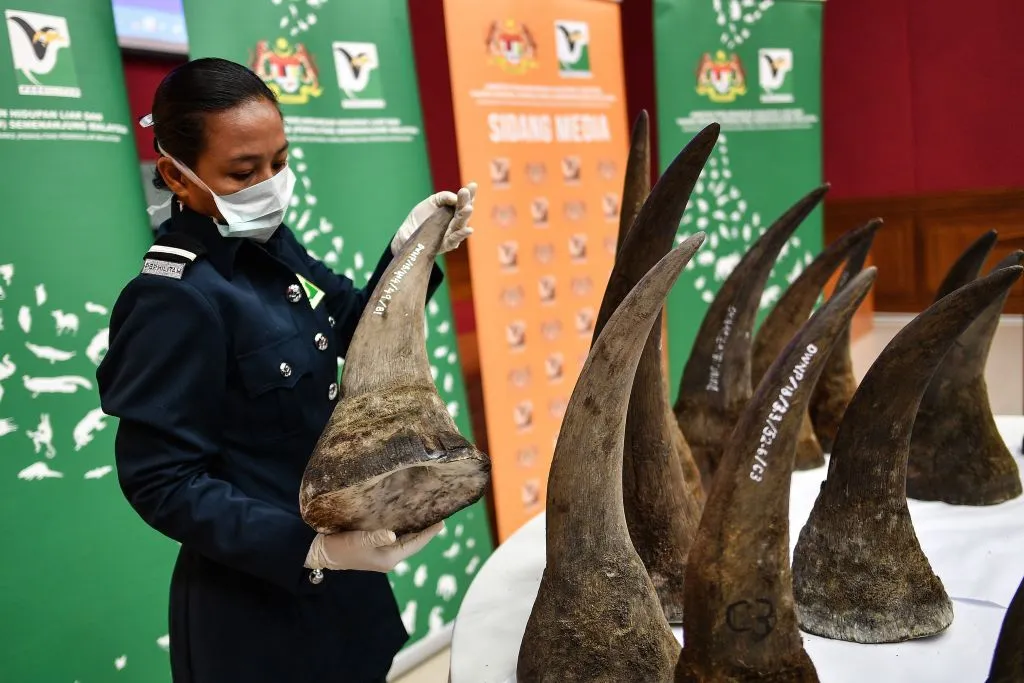
Between 2021 and 2023, global authorities seized more than 1.8 tonnes of rhino horn — the equivalent of over 700 whole horns. South Africa accounted for about two-thirds of the confiscated volume, with many shipments headed toward Malaysia and Vietnam.
Despite pressures from southern African nations, conservationists say rhino populations remain extremely vulnerable, and any move to legalize horn trade would pose severe risks to already threatened species.