
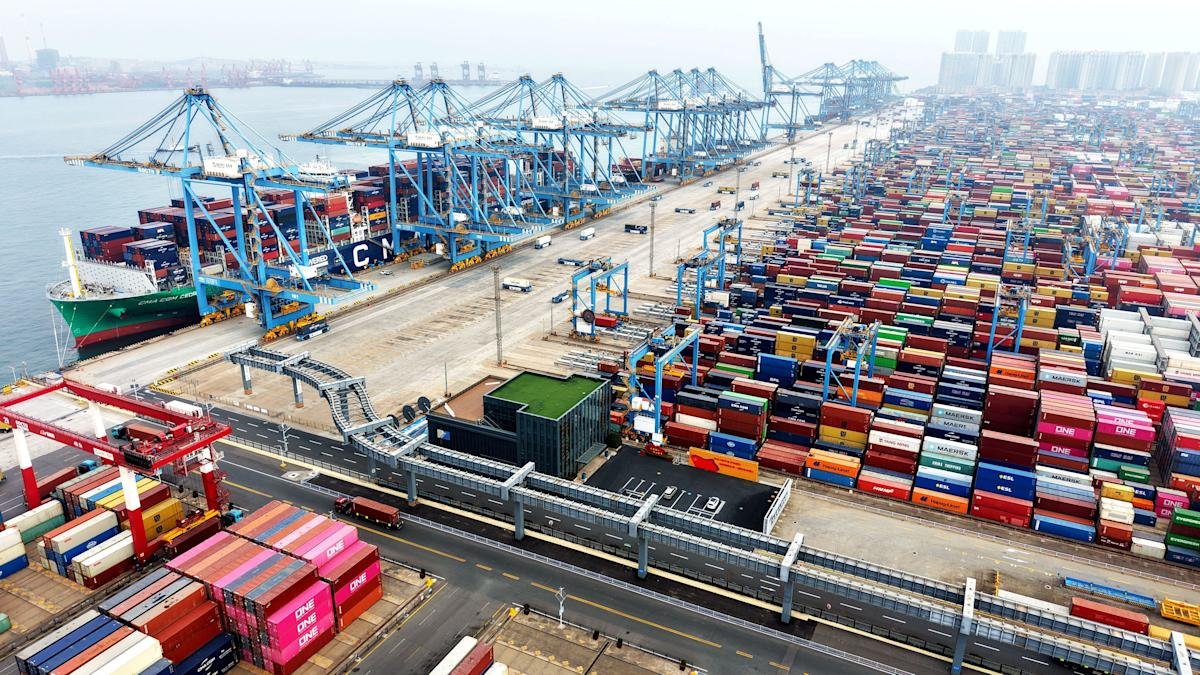
China has announced a record-breaking trade surplus for 2025, defying expectations that United States tariffs under President Donald Trump would significantly slow its export-driven economy.
According to figures released by Beijing on Wednesday, China’s full-year trade surplus hit $1.19 trillion (£890bn) — the largest ever recorded by any country. This marks the first time China’s annual surplus has crossed the $1tn threshold, surpassing the previous 2024 record of $993bn.
Despite turbulence caused by Trump’s aggressive tariff policies, China posted monthly trade surpluses above $100bn on seven occasions last year. This suggests that US trade measures had only a limited impact on China’s overall global trade performance.
While exports to the US declined, China compensated by sharply increasing sales to South East Asia, Africa, Latin America, and parts of Europe.
Speaking at a press conference, Wang Jun, deputy director of China’s customs authority, described the figures as “extraordinary and hard-won,” citing “profound changes” and growing uncertainty in global trade conditions.
He also highlighted strong growth in exports related to green technology, artificial intelligence, and robotics, sectors Beijing has heavily invested in.
Why China’s Surplus Grew So Large
Economists point to several factors behind the surge:
- Strong global demand for Chinese goods
- Weak domestic consumption, reducing imports
- A prolonged property sector crisis and rising debt, which have slowed investment
- A weaker yuan, making exports more competitive
- Inflation in Western economies, increasing demand for cheaper Chinese products
China’s imports grew by just 0.5%, reflecting cautious consumer spending and reduced industrial demand at home.
A Double-Edged Sword for Beijing
Trade policy analyst Deborah Elms of the Hinrich Foundation described the results as a “mixed blessing.”
On one hand, China has benefited from increased overseas sales and job creation. On the other, its export dominance could attract greater scrutiny and protectionist pushback from foreign governments struggling to compete with low-priced Chinese goods.
Several countries have already raised concerns about their markets being flooded with Chinese products, sparking fears of dumping and unfair competition.
Elms believes China’s export momentum could continue into 2026, as its goods and services become even more embedded in global supply chains.
Trump Tariffs Still Loom Large
Businesses worldwide remain braced for another year of uncertainty as tariff tensions persist. In April last year, President Trump unsettled global markets by imposing sweeping tariffs on goods from over 90 countries, with China facing some of the harshest measures.
The dispute escalated into threats of triple-digit tariffs before both sides eased tensions following a meeting between Trump and Chinese leader Xi Jinping in South Korea in October.
Although more extreme measures were paused, moderate tariffs remain in place, continuing to weigh heavily on Chinese exports to the US.
Beijing sees the latest figures as proof that China is not dependent on the US market alone. Still, Wang Jun cautioned that the external environment remains unpredictable, warning that global trade conditions could become even more challenging in the year ahead.