
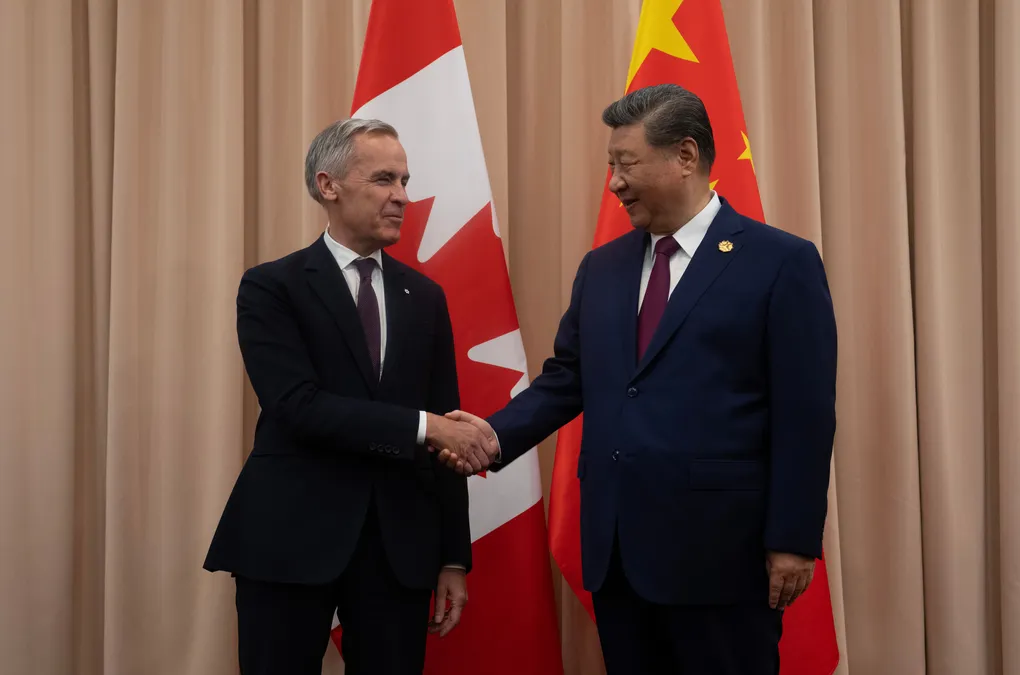
Canada’s Prime Minister Mark Carney is travelling to China on a critical visit aimed at rebuilding relations with Beijing while carefully managing the risks such engagement could pose to Canada’s ties with the United States, national security interests, and human rights commitments.
The trip comes at a time when Canada is actively seeking to diversify its trade relationships amid uncertainty over its economic future with the US, its largest trading partner. Senior Canadian officials have described the visit as both historic and consequential, noting that it is the first official trip to China by a Canadian prime minister since 2017 and part of a broader plan to double Canada’s non-US exports over the next decade.
Trade discussions are expected to dominate the agenda, alongside talks on agriculture, international security, energy, and climate cooperation. Chinese authorities have said both countries share common interests and should work to strengthen people-to-people and cultural exchanges. During the visit, Carney is scheduled to meet China’s Premier Li Qiang and Zhao Leji, Chairman of the Standing Committee of the National People’s Congress, before holding one-on-one talks with President Xi Jinping.
The visit marks a notable step in repairing relations that sharply deteriorated in 2018 after the arrest of Huawei executive Meng Wanzhou in Vancouver on a US extradition request. Beijing responded by detaining two Canadians on espionage charges, triggering years of diplomatic tension. All three individuals were released in 2021 following a deal between Meng and US prosecutors.
Relations have remained strained in recent years, with Canada accusing China of political interference, allegations Beijing has repeatedly denied. Although a public inquiry found limited impact on Canadian elections, Ottawa continues to view China as an increasingly disruptive global power that often disregards international norms. Despite this, Canadian officials acknowledge that meaningful engagement with China is unavoidable given its global influence and economic weight.
The Carney government has stressed that the visit does not signal a softening of its stance on China, but rather a pragmatic effort to advance Canadian interests. Officials say Canada cannot realistically reduce its reliance on the US market without expanding trade with China, even as it seeks to set clear boundaries in sensitive areas such as defence and critical minerals.
One key objective of the trip is to push for the removal of Chinese tariffs on Canadian canola, which have significantly affected farmers in western Canada. The tariffs were widely seen as retaliation for Canada’s levies on Chinese electric vehicles introduced last year, in line with similar measures taken by the US. China has openly signalled that it wants those EV tariffs lifted.
The balancing act has already been evident domestically. Ahead of Carney’s visit, two Canadian MPs ended a sponsored trip to Taiwan early, citing the need to avoid confusion over foreign policy during the prime minister’s engagement in Beijing.
From China’s perspective, Canada is an important trading partner, with bilateral trade valued at about $118bn in 2024. Analysts suggest Beijing also sees an opportunity to gain influence in a country closely aligned with the US. Chinese state media has urged Canada to pursue a more independent foreign policy and reduce what it describes as automatic alignment with Washington.
A major question hanging over the visit is how the US will respond to any agreements reached. Canada has been hit hard by US tariffs on steel, aluminium, and automobiles, and negotiations to ease those measures remain stalled. At the same time, Canada is preparing for crucial talks later this year on renewing its North American free trade agreement with the US and Mexico.
Former Canadian diplomat Colin Robertson has noted that Washington is likely monitoring the Canada-China relationship closely, even as Ottawa keeps US officials informed of its intentions. Ultimately, he says, Canada is acting in pursuit of its own national interests, even as it navigates one of the most complex diplomatic balancing acts it has faced in years.