
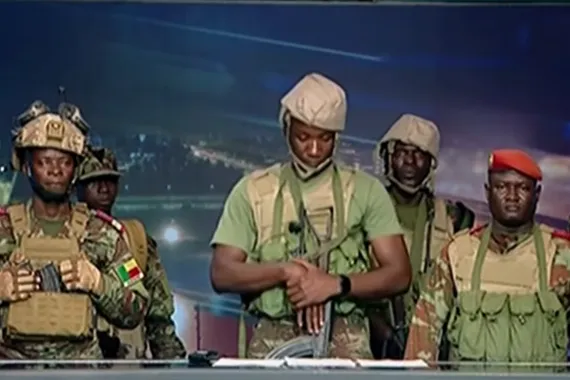
Authorities in Benin are intensifying their search for the soldiers behind Sunday’s attempted coup, as reports confirm that two senior military officials who were taken hostage have now been released. A government insider told the BBC that the circumstances surrounding their freedom remain uncertain, and there is still no clarity on whether other captives are being held.
Security forces continue to comb strategic areas for the fugitive coup plotters, who briefly attempted to seize control of the West African nation. Early on Sunday, a group of mutinous soldiers appeared on state television claiming to have taken power. Moments later, gunfire was heard near the presidential residence in Cotonou.
However, President Patrice Talon swiftly reassured the nation, declaring that loyal forces had regained control of all key locations. Nigeria later confirmed that it supported Benin’s counter-operation, saying its fighter jets were deployed at the request of Benin’s government to push the mutineers out of the national broadcaster and a military camp.
Massive explosions later rocked Cotonou, believed to be linked to an airstrike during the operation. Flight-tracking data revealed that three aircraft entered Benin’s airspace from Nigeria before returning, but the extent of the damage has not yet been revealed.
By Sunday afternoon, spokesperson Wilfried Leandre Houngbedji announced that 14 suspects had been arrested. According to a local journalist, 12 of them were part of the group that stormed the national TV station, including a previously dismissed soldier. The mutineers claimed they were being led by Lt Col Pascal Tigri, whose location remains unknown.
In a national address, President Talon praised security forces for neutralising “the last pockets of resistance,” describing the attempted takeover as treachery that would face firm punishment. While the government has not confirmed whether there were casualties, the president expressed sympathy for “victims of this senseless venture” and those still in captivity.
Meanwhile, the regional bloc ECOWAS has deployed additional troops from Nigeria, Ghana, Sierra Leone, and Ivory Coast to stabilise strategic installations and guard against renewed unrest. The bloc has come under pressure to halt a rising wave of coups across West Africa.
Benin, long seen as one of the region’s more stable democracies, now finds itself confronting the same instability that has affected neighbouring Niger, Burkina Faso, Guinea, and Mali. The country remains one of Africa’s top cotton producers but continues to battle poverty and jihadist threats spilling from the Sahel.
The coup plotters accused President Talon of mismanaging national security and neglecting families of soldiers killed in the northern conflict zones. They also criticised recent austerity measures, including cuts to healthcare services, increased taxes, and tighter restrictions on political activities.
President Talon — a close ally of Western nations — is scheduled to leave office next year after his second term. He has endorsed Finance Minister Romuald Wadagni as his preferred successor. Though his supporters credit him with economic reforms, his administration has faced criticism over the suppression of opposition figures. The electoral commission recently blocked the main opposition candidate, citing insufficient sponsorship.
This attempted coup unfolded only days after President Umaro Sissoco Embaló of Guinea-Bissau was removed from power, raising fears of a destabilizing domino effect in the region. Russia’s growing influence in the Sahel has also drawn attention, with pro-Russian accounts online praising the Benin takeover attempt.
Both the African Union and ECOWAS have strongly condemned the coup attempt.