
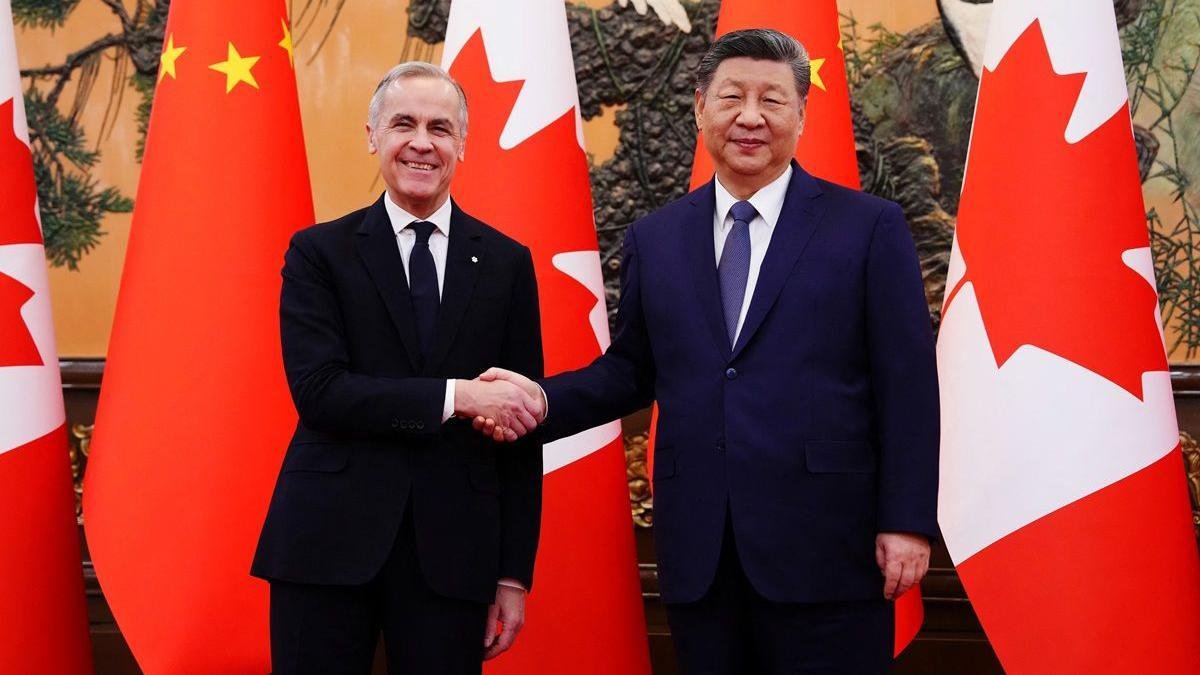
China and Canada have agreed to significantly ease trade tariffs following a high-level meeting between Chinese leader Xi Jinping and Canadian Prime Minister Mark Carney in Beijing, marking a clear shift toward repairing years of strained relations.
Under the agreement, China will cut tariffs on Canadian canola oil from 85% to 15% by 1 March, while Canada will lower taxes on Chinese electric vehicles to the most-favoured-nation rate of 6.1%. The announcement represents a major breakthrough after prolonged tit-for-tat trade measures that had weighed heavily on bilateral commerce.
Xi described the outcome as a “turnaround” in China–Canada relations, while the deal also boosts Carney’s efforts to reposition Canada’s global trade strategy. Carney is the first Canadian leader to visit China in nearly a decade and has been pushing to reduce Canada’s reliance on the United States amid uncertainty created by repeated tariff shifts under President Donald Trump.
Speaking to reporters, Carney said relations with China had become more predictable in recent months and described the discussions as realistic and respectful. He stressed, however, that Canada had made its red lines clear, citing concerns over human rights, election interference, and the need for firm diplomatic guardrails.
“We take the world as it is, not as we wish it to be,” Carney said when asked about China’s human rights record, adding that engagement with Beijing would be selective and issue-focused.
Analysts say the agreement could pave the way for increased Chinese investment in Canada and may influence other countries affected by US trade policies to deepen ties with Beijing. China, for its part, has been positioning itself as a stable and pragmatic global partner, a message Xi reinforced by calling for “healthy and stable” relations that support global peace and prosperity.
The tariff reset addresses one of the most contentious issues between the two countries. In 2024, Canada imposed steep duties on Chinese electric vehicles, prompting Beijing to retaliate with tariffs on more than $2bn worth of Canadian agricultural products. Those measures contributed to a sharp drop in Canadian exports to China in 2025.
As part of the new deal, Canada will allow up to 49,000 Chinese electric vehicles into its market at the reduced tariff rate, a move designed to balance trade openness with concerns from domestic automakers. China will also lower tariffs on Canadian seafood and agricultural exports, including lobster, crab, and peas.
Although China remains Canada’s second-largest trading partner, it still lags far behind the US in overall trade volume. Even so, economic ties with Beijing are growing in importance for Ottawa. During his visit, Carney also met senior executives from major Chinese firms and oversaw the signing of several cooperation agreements covering energy and trade.
Observers describe the visit as a pragmatic reset rather than a full reconciliation, shaped by geopolitical shifts and global trade tensions. Carney acknowledged that Canada and China operate under different political systems, which limits the scope of cooperation, but said direct dialogue was essential.
“To have an effective relationship, we speak directly,” he said. “We don’t conduct diplomacy through megaphones.”