
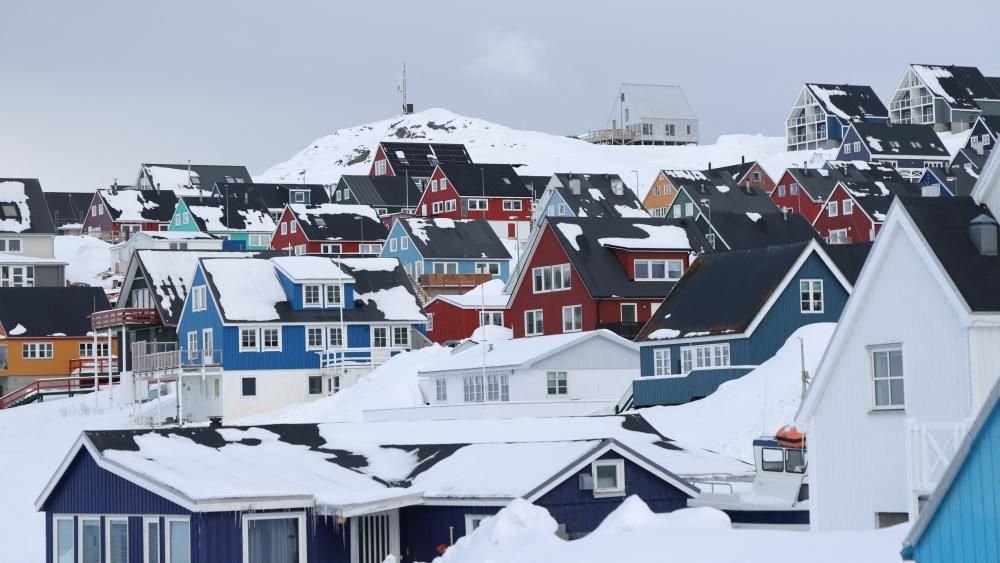
Greenlanders are anxiously awaiting a high-stakes meeting in Washington that could determine not only the future of the world’s largest island but also the balance of power in the Arctic. US Vice-President JD Vance is hosting talks with the foreign ministers of Denmark and Greenland, alongside US Secretary of State Marco Rubio, as global attention focuses sharply on Greenland’s strategic importance.
In Nuuk, the capital, electronic news tickers flash words like “Trump,” “Greenland,” and “sovereignty” in bold red letters, reflecting the growing unease across the island. President Donald Trump has openly declared his desire for Greenland, insisting the United States needs it for national security and warning he would take it “the easy way or the hard way.” After recent US military actions abroad, many Greenlanders say they are taking those words seriously.
Residents have voiced strong opposition to any notion of Greenland being taken over. Some say they want independence and self-determination, not to be sold or absorbed by another power. Parents worry about the future for their children, while artists, writers and ordinary citizens alike express frustration at the sudden and intense global spotlight on their homeland.
The stakes extend far beyond Greenland itself. The dispute places two Nato allies, Denmark and the United States, on a potential collision course. Greenland is a semi-autonomous territory of Denmark, and Danish Prime Minister Mette Frederiksen has warned that any US attempt to seize the island by force would effectively spell the end of the transatlantic alliance that has underpinned European security for decades. Such a rupture would further strain already fragile US-European relations and complicate efforts to maintain unity over issues like Ukraine.
Washington insists its interest in Greenland is driven by security concerns, arguing that if the US does not act, China or Russia will move in. In response, European powers have been scrambling to propose measures to strengthen Nato’s presence in Greenland and the wider Arctic. Germany and the UK have been leading discussions on enhanced surveillance, military exercises and potential deployments, while France has announced plans to open a consulate in Greenland as a political signal of support for Danish sovereignty.
Behind the scenes, Nato discussions are exploring options ranging from increased naval patrols and air surveillance to anti-drone systems and even a dedicated Arctic maritime security initiative similar to those already operating elsewhere in Europe. Denmark has already moved to send additional military personnel to Greenland to prepare for possible reinforcements.
Greenland’s strategic value is not new. During the Second World War, the US occupied the island to prevent Nazi control, and in 1951 a defence agreement with Denmark allowed the US to establish and maintain military bases there. Today, Greenland’s position on the shortest route between North America and Russia makes it vital for missile defence and early warning systems. Its surrounding waters also form a critical maritime chokepoint used to monitor submarine activity between the Arctic and the Atlantic.
While Denmark has pledged billions of dollars to strengthen Greenland’s security, the Trump administration has dismissed these efforts as insufficient. Analysts question whether any Nato-led security proposals will satisfy a White House that appears increasingly focused on territorial expansion rather than cooperation.
Some experts argue that if security were the sole concern, the US would focus more on areas like the Bering Strait near Alaska, where Russian and American interests collide directly. They suggest Trump’s fixation on Greenland may be driven as much by economic interests as by defence considerations. Greenland is rich in rare earths and other critical minerals essential for advanced technologies, and melting Arctic ice could open new shipping routes of enormous commercial value.
Despite these pressures, Greenlanders remain firm in their stance. Polls show most want eventual independence from Denmark, but an overwhelming majority reject becoming part of the United States. Greenland’s prime minister has made clear that if forced to choose, his country would stand with Denmark.
As the Washington meeting approaches, uncertainty looms large. Observers say the outcome may hinge less on diplomatic proposals and more on President Trump himself, whose unpredictability has become a defining feature of US foreign policy. Many warn that any attempt to take Greenland through coercion would have far-reaching consequences, potentially undermining Nato and reshaping the global order. Russia and China, like Greenlanders, will be watching closely, aware that the future of the Arctic — and much more — could be decided in a single meeting.