
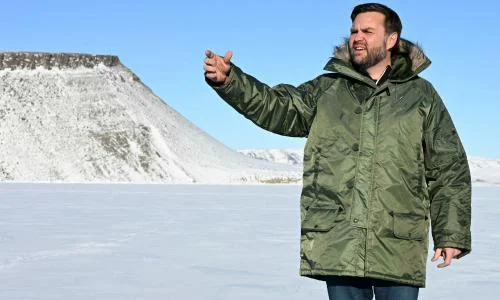
US Vice-President JD Vance has criticised Denmark and other European allies over what he described as a failure to properly secure Greenland, calling the Arctic territory “critical” to global and American security.
Speaking in an interview with Fox News, Vance said Greenland plays a vital role in missile defence against potential threats from Russia and China, but argued that Europe and Denmark have under-invested in the region’s security infrastructure and failed to seriously engage with President Donald Trump’s position on its strategic importance.
His remarks come amid growing tension after the White House confirmed that US officials are actively discussing a potential offer to purchase Greenland, a semi-autonomous Danish territory. Earlier this week, the Trump administration also suggested that military action to annex the island had not been ruled out.
Denmark, a Nato ally of the US, has warned that any attempt to seize Greenland would fundamentally undermine the alliance. Both Copenhagen and Greenland’s leadership have repeatedly insisted that the territory is not for sale.
Despite being the world’s most sparsely populated territory, Greenland occupies a key strategic position between North America and the Arctic. Its location makes it crucial for early-warning missile defence systems and for monitoring military and commercial activity in the region.
The United States already maintains a military presence in Greenland, with more than 100 personnel stationed at the Pituffik Space Base in the island’s north-west. Under existing defence agreements with Denmark, Washington is permitted to deploy additional forces to the territory if it chooses.
Interest in Greenland has also increased due to its vast natural resources, including rare earth minerals, uranium and iron. As climate change accelerates ice melt, scientists believe previously inaccessible oil and gas reserves could also become viable.
“People don’t realise that much of the missile defence infrastructure depends on Greenland,” Vance said. “If a missile were launched at North America or Europe, Greenland would be a critical part of detecting and responding to that threat.”
He questioned whether Denmark and its European partners had done enough to maintain Greenland’s role as a cornerstone of global security, answering his own question by saying they “obviously haven’t”.
Tensions around Greenland intensified following the Trump administration’s recent military operation in Venezuela, which resulted in the seizure of President Nicolás Maduro. The move raised concerns in Europe that Washington could pursue similarly aggressive actions elsewhere.
Trump first floated the idea of buying Greenland in 2019, during his first term in office, but was firmly rebuffed by Danish authorities.
US Secretary of State Marco Rubio is expected to hold talks with Danish officials next week as diplomatic pressure mounts.
In response to the growing dispute, leaders from France, the UK, Germany, Italy, Poland, Spain and Denmark issued a joint statement affirming that Greenland’s future must be decided by its people and the Danish kingdom alone. They emphasised that Arctic security should be handled collectively through Nato and in line with international law.
Aaja Chemnitz, one of Greenland’s representatives in Denmark’s parliament, described the US rhetoric as a “clear threat”, accusing Washington of showing disrespect to a fellow Nato ally by refusing to rule out annexation.
Meanwhile, some Greenlanders expressed frustration with both sides. Aleqatsiaq Peary, an Inuit hunter from the northern town of Qaanaaq, told the BBC that US ownership would simply mean “switching from one master to another”.
He said many local communities are more concerned about the effects of climate change, which is melting sea ice and threatening traditional hunting livelihoods, than about geopolitical power struggles.